Curriculum
ST MARKS FAMILY MEDICINE CLINIC (SMFM)
At the heart of Family Practice is continuity in taking care of your own panel of patients. Most residencies start out with minimal clinic exposure and a lot of time in the hospital. Our program puts a major emphasis on your personal clinic experience, the foundation of a successful Family Physician. Our trademarked program is called Clinic Every Day. During all three years of the residency you will see patients at SMFM 5 days per week, even when you are on call - just like when you are out in practice.
Being in clinic on a daily basis means:
1) when your patients call, the receptionist will tell them that you'll be in today or tomorrow, not next week like a traditional program,
2) when lab results come back, you'll review them immediately and take appropriate action, and
3) when you see a really sick patient who needs follow-up tomorrow, you'll do the follow-up visit on your patient, not your colleague whom the patient hasn't met.
SMFM is based right out in the community where the patients are. We see approximately 15,000 patients per year.
NOON CONFERENCE DIDACTICS
Every weekday there is a noon conference with lunch provided. The topics covered are diverse from an EKG course to Balint Group, where residents discuss how they feel about certain patient interactions (without the faculty present). The speakers include the residency faculty, rotation directors, resident presentations, and many outside speakers too. Residents are in charge of scheduling the lectures, so we get the lectures we want.
ROTATIONS
Family Medicine Hospital Service (FMS)
Patients are admitted to the hospital from our Family Medicine Clinic (FMC) and from the community.
Details:
R1 patient load is 6-8 patients/day, diminishing toward the weekend
Pharmacy rounds with our team every day
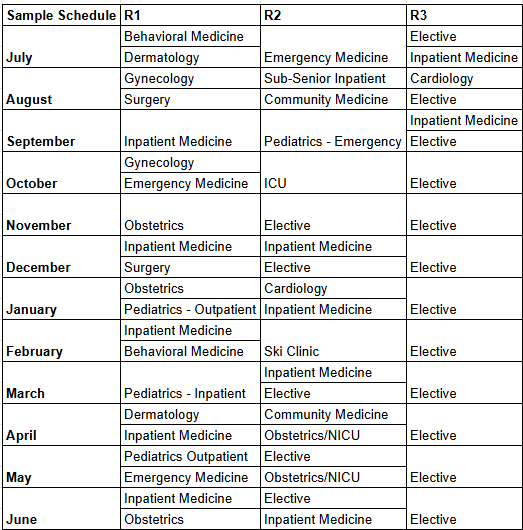
Rotation length: R1 - 3 months (1 month, then split into 2 week blocks); R2 - 2 months (2 weeks blocks); R3 - 1 month (2 week blocks)
General schedule:
R1s from 7 AM - 9PM Monday (for general hospital admits); 7 AM – 7 PM Tuesday – Friday, Saturday off, Sunday morning rounds
Interns manage the service independently under the attending on Monday mornings and Tuesday afternoons
Attendings and senior residents who are not on service are always available for guidance
R2/R3s 12 PM Monday – 12 PM Tuesday (overnight), 7 AM – 7 PM Tuesday – Friday, Saturday morning rounds, Sunday off
Call Schedule
Home call: residents who live within a 30-minute radius of the hospital can take call from home. Call includes managing questions about existing admitted patients on our inpatient service and phone calls from patients in the clinic. You are only required to go into the hospital for a new admission of our clinic patients or if an existing admitted patient becomes unstable. Home call allows for better work-life balance. We do not have any night flow rotations.
R1 - no overnight call
R2 and R3: on call from home for our inpatients, admissions of any of our clinic patients, and phone calls from patients at our clinic. Averages q8 weekdays and q8 weekends
Obstetrics/Gynecology:
Residents complete 3 months of OB care over 3 years.
Minimum delivery numbers: 30 non-continuity patients, 10 continuity patients.
Opportunity for more deliveries per resident interest (see OB track in Track tab)
We deliver at St. Mark’s Hospital and work closely with the OBGYN group at St. Mark’s and OB hospitalists during the month
All continuity deliveries will be delivered with our own family medicine - OB fellowship-trained faculty member, Dr. Maryana Boulos.
Time is split between OB clinic, L&D deck, and our continuity clinic
Advanced Life Support in Obstetrics (ALSO) training is provided during R1
Residents work one-on-one with attendings in the community, ranging from general gynecology practices, gyn-onc clinic, and the pelvic pain clinic
Surgery:
Residents work the St. Mark’s general surgeons for their surgery rotation.
Experience developed in preoperative diagnosis, intubation, suturing, surgical assisting, postoperative management, and ambulatory surgical procedures. You can spend time in surgery clinics or with the wound care team.
Behavioral Medicine:
Residents work with psychiatrists at St. Mark’s Behavioral Health Unit and psychiatrists in the community.
Residents perform a reflective session annually during noon conference, and behavioral medicine is addressed 2-3 times per month in noon conference
Dermatology:
Residents work with clinicians in the community, including those performing Moh’s surgery
Sports Medicine/Orthopedics:
Residents work with clinicians at St. Mark’s and in the community.
Rotate with our sports medicine fellowship-trained faculty, Dr. Emily Miro
Winter ski clinic during R2 seeing many patients with sports injuries
Gain experience in casting, splinting, joint aspirations, POCUS, and injections.
Opportunities to complete pre-sports evaluations and be the team doctor in various venues
Cardiology:
Residents work with Cardiologists at St. Mark’s renowned Heart Center in their clinic and on the inpatient service.
Emergency Department:
Residents work at St. Mark’s ER for a total of 2 months (200 hours)
Residents also work at the Primary Children’s Emergency Department for a dedicated pediatric emergency rotation
The St. Mark's Hospital ER has 40,000 visits per year and is a Level II Trauma Center.
Certification in ACLS in the first year
Optional ATLS training during residency using CME money
Pediatrics:
Residents work on a Family Medicine inpatient team at Primary Children’s Medical Center (PCMC) during the busy winter months
Residents see well babies in the nursery while on the Obstetrics/Gynecology service.
R1s - one month of outpatient pediatrics with one of many community general or specialist pediatricians, and one month of inpatient pediatrics at PCMC
R2s - one month of pediatrics ER at PCMC, and one month of outpatient pediatrics or NICU at St. Mark's Hospital under the supervision of the staff neonatologists.
PALS and NRP are provided in the first year
ICU:
One month in the second year with one-on-one training with the intensivist physicians at St. Mark's Hospital
Opportunity to learn many aspects of critical care, including intubation, ventilator and pressor settings, arterial and central line placement, and pulmonology procedures
Community Medicine/Population Health:
Residents explore community resources, such as the county health department, poison control, community health clinics (i.e., Maliheh Free Clinic), an HIV clinic, AA meetings, and an occupational medicine facility.
Residents may also work on their research and QI projects during this month
Geriatrics:
Residents follow 5-6 long term nursing facility patients during R2 and R3 years
Home visits and hospice visits completed during this rotation
Preceptorship:
This very important rotation gives the resident a chance to experience potential future practice opportunities. Options available include rural, suburban, and academic practices.
Practice Management:
Residents spend a month honing their business in medicine skills
Residents need to learn the business side of medicine, and this is the rotation to do it.
Residents also attend a hospital committee through residency to further their understanding of hospital management
Coding and billing is taught throughout residency, including didactics from our in-house coding staff
Radiology:
The radiologists at St. Mark's Hospital teach our residents about plain films, CT, MRI, mammography, ultrasound, and nuclear medicine.
Residents read the X-rays in the FPC on their own patients, and then the films are over-read by a radiologist for teaching and quality control.
Lifestyle Medicine:
St. Mark's Family Medicine is committed to training future physicians in the principles of Lifestyle Medicine, equipping residents with the skills to promote health and wellness through evidence-based lifestyle interventions. With a focus on nutrition, physical activity, stress management, and other key areas, our residents gain comprehensive training to address the root causes of chronic disease and improve patient outcomes.
Elective Rotations:
Some of the options available include: pulmonology, ophthalmology, GI, ENT, plastic surgery, a procedures clinic, podiatry, endocrinology, rheumatology, allergy, sports medicine, urgent care, and numerous pediatric subspecialties or best yet, set up a rotation abroad.
ANNUAL RETREAT
Part of our curriculum is having fun. Each year our program has an annual retreat in an out-of-town location. In recent years, we have retreated in Park City and Solitude Resort.
Procedures
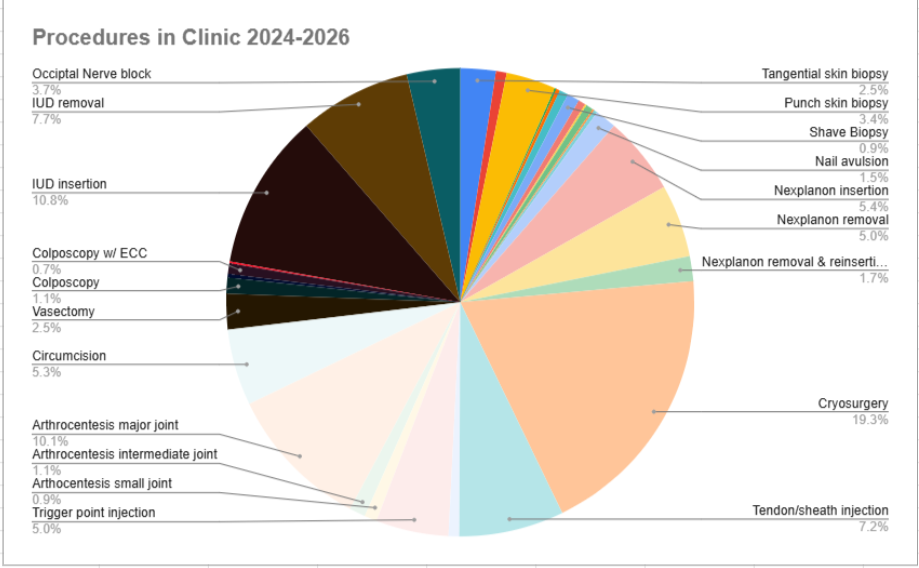
We get a wide variety of procedural experience both in the clinic and on our rotations: